News
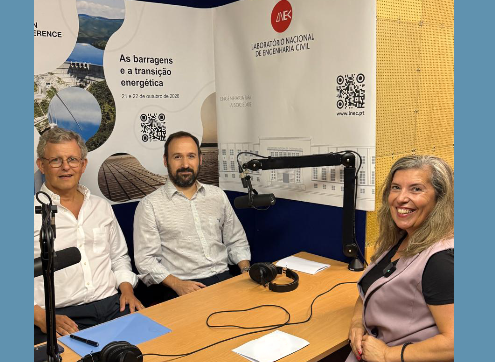
LLC Podcast - Episode 11 - Sérgio Costa and Filipe Roberto, Engineers - Aqualogus
09 October 2026
Today we bring you the 11th episode of the official LNEC Lisbon Conference 2026 podcast.
In this episode, we spoke to Eng. Sérgio Costa (Manager and Development Director) and Eng. Filipe Roberto (Deputy Director of the Dams Department), both from Aqualogus, about the role of dams and hydropower in the energy transition, as well as the engineering challenges faced in national and international contexts.
With the rapid growth of solar and wind energy, hydroelectric power plays a crucial role focused less on pure generation and more on grid flexibility, stability, and energy storage. As Eng. Sérgio Costa points out, Aqualogus has increasingly focused its work on the rehabilitation of existing infrastructures, dam safety studies, and environmental enhancement to address modern grid mix challenges.
The company's extensive international experience - spanning complex geographies such as the Himalayas in Pakistan, as well as projects in Africa and PALOPs - highlights Portugal's high maturity in water resource management. However, these global projects challenge traditional engineering paradigms, such as seismic analysis in high-activity zones, and offer profound human insights through engagement with local communities and diverse administrative frameworks.
Digitalization, digital twins, and BIM methodologies were also highlighted as transformative tools. Eng. Filipe Roberto notes that these technologies allow engineers to integrate historical and geometric asset data seamlessly, helping to anticipate anomalies, streamline multidisciplinary projects, and enhance the safety and resilience of dams.
Finally, the guests encourage younger generations to explore the real benefits of dams in grid regulation and energy storage, highlighting that the LNEC Lisbon Conference 2026 will be the prime venue to discuss these crucial topics.
Registration details and the full programme are available HERE.
Subscribe to our podcast and follow all the episodes on Spotify and YouTube.