News
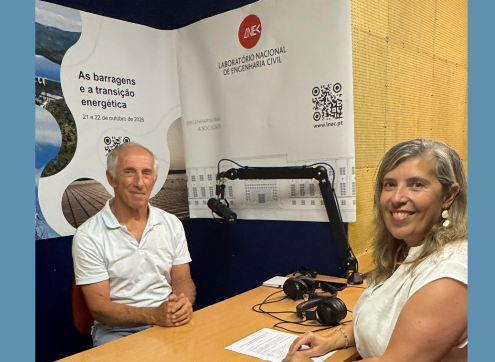
LLC Podcast – Episode 6 – João Mattos Parreira, Engineer – Aguia Enlica
21 August 2026
Today we bring you the sixth episode of the official LNEC Lisbon Conference 2026 podcast.
This week, we spoke to Eng. João Mattos Parreira, representing Aguia Enlica, about hydroelectricity, storage and modernisation – the major challenges of the energy transition.
Hydropower continues to play an essential role in the Portuguese electricity system, not only because of its renewable generation capacity, but also because of its contribution to the stability and resilience of the grid. “Hydropower plays a very important role,” he states, emphasising its ability to compensate for the intermittency of other renewable sources.
For the engineer, the importance of hydroelectricity goes beyond energy generation. Hydroelectric power stations can contribute to the security and stability of the grid, including in extreme situations such as a blackout. The so-called “synchronous inertia” of the turbines allows, as he explains, for a margin of response to variations in grid frequency. “Hydropower generation provides a great deal of resilience to the grid’s security,” he summarises.
Pumped storage therefore emerges as one of the key elements in increasing the integration of solar and wind energy. In João Mattos Parreira’s view, Portugal has particularly favourable conditions for exploiting this solution and could combine the growth of renewables with sufficient storage capacity to cope with periods of lower generation.
In this episode, we also discuss the modernisation of hydroelectric power stations, the potential of self-consumption and batteries, the repowering of wind farms, and the specific challenges facing small hydroelectric power stations. In the latter case, digitalisation and artificial intelligence already make it possible to manage different power stations collectively and optimise production according to weather and market conditions.
The LNEC Lisbon Conference 2026, dedicated to dams and the energy transition, will take place on 21 and 22 October. Registration and the full programme are available HERE.
Subscribe to our podcast and listen to all episodes on Spotify and YouTube.