News
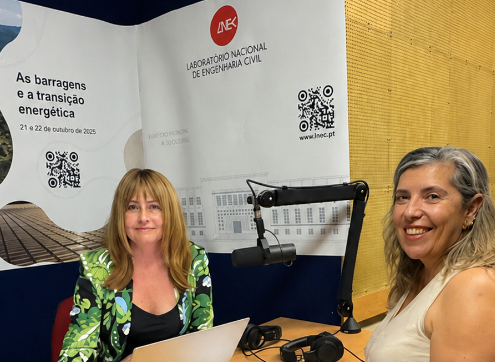
LLC Podcast – Episode 7 – Laura Esteves, Engineer – Teixeira Duarte
04 September 2026
Today we bring you the 7th episode of the official LNEC Lisbon Conference 2026 podcast.
In this episode, we spoke to Eng. Laura Esteves, project director at Teixeira Duarte, about the construction, refurbishment and modernisation of dams and hydroelectric power stations - and about the role of engineering in the energy transition.
Construction has been part of the history of human civilisation. From the earliest structures to today’s large-scale systems, building has meant providing protection, connecting regions, organising communities and instilling confidence in the future. In the case of dams, this aspect takes on a particularly demanding scale: they are large-scale engineering projects that have an impact on regions and populations, but are also essential infrastructure for energy production and storage.
The interview began with a central question: is it more challenging today to modernise and refurbish an existing dam than to build a new one? The answer lies, first and foremost, in sustainability. Whenever possible, utilising existing infrastructure allows us to make the most of materials and investments already in place, whilst avoiding further territorial and environmental impacts. As Laura Esteves states, “generally speaking, there is no project more sustainable than one that already exists”.
Renovation work, however, takes place on structures that remain in operation and are subject to stringent safety requirements. Shutdowns and maintenance windows must be carefully planned. Digital technologies can support this process. Laser scanning enables a point cloud of the existing infrastructure to be obtained and, using other methodologies, this can be transformed into an accurate digital model. Digital modelling facilitates collaboration between teams, the coordination of projects and the early analysis of solutions. It also allows materials, processes and alternatives to be tested before on-site implementation, helping to reduce inefficiencies, control costs and deadlines, and improve environmental performance.
Engineer Laura Esteves’s final message is clear: “If construction changes, the world changes”. As a sector with a very significant impact on emissions, employment and resource consumption, construction has a unique capacity to generate a positive impact. The challenge lies not only in building more, but in rehabilitating, modernising and managing the existing built environment more intelligently, bringing engineering closer to research, innovation and universities.
The LNEC Lisbon Conference 2026, dedicated to dams and the energy transition, will take place on 21 and 22 October.
Registration and the full programme are available HERE.
Subscribe to our podcast and follow all the episodes on Spotify and YouTube.