News
LLC Podcast – Episode 9 – Pedro Ribeiro, Engineer – Movhera
25 September 2026
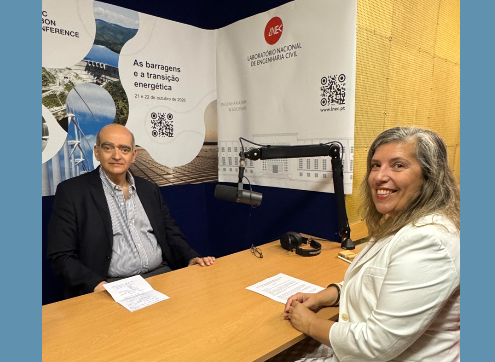
Today we bring you the 9th episode of the official LNEC Lisbon Conference 2026 podcast.
In this episode, we spoke to Eng. Pedro Ribeiro, from Movhera, about the role of hydropower in the stability of the electricity system, pumped storage and the technological modernisation of power plants.
Hydropower accounts for an average of 25% to 30% of Portugal’s annual electricity generation and stands out as a dispatchable renewable source, capable of contributing to grid predictability and stability. Pumped storage also makes it possible to store surplus solar and wind energy, increasing the integration of renewable sources into the system. As Pedro Ribeiro explains, “pumped storage provides energy storage”.
The interview also explores the future development of the energy system. Although hydropower generation may decline in absolute terms, its importance is expected to grow during periods of peak demand and in the provision of system services, such as frequency and voltage control and emergency reserves. “In terms of quantity it decreases; in terms of quality, it increases,” the engineer summarises.
Digitalisation is another major transformation under way. CFD models, digital twins, BIM, sensors, satellite monitoring and predictive maintenance can improve the design, operation and conservation of infrastructure. These technologies help anticipate problems, reduce interference and preserve the technical memory of power plants, although their application must always be carefully assessed and adapted to each solution.
Pedro Ribeiro also highlights the importance of bringing together different areas of expertise and finding a balance between energy needs, infrastructure safety and environmental protection. “We need energy, but we also need to preserve the environment,” he states.
The LNEC Lisbon Conference 2026, dedicated to dams and the energy transition, will take place on 21 and 22 October.
Registration and the full programme are available HERE.
Subscribe to our podcast and follow all episodes on Spotify and YouTube.