News
LNEC receives course "Design, Construction, Exploration and Rehabilitation of Small Dams"
27 November 2024
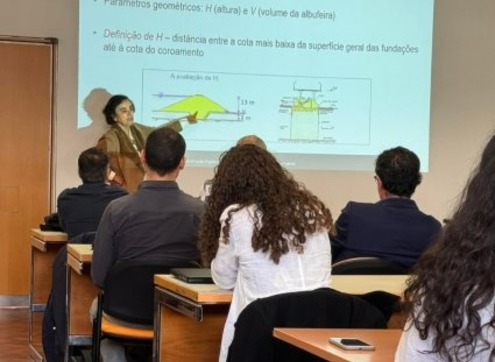
LNEC received a course on "Design, Construction, Exploration and Rehabilitation of Small Dams" to allow the correct exploitation of this resource. Aimed at dam engineers and technicians, the training focused on the specificities of small dams, which are essential to face environmental challenges and promote sustainability, with the aim of improving their operation, maintenance and rehabilitation practices. Geometric criteria in volume and height define and distinguish what is a large dam from a small one.
Small dams represent a strategic alternative in the management of water resources, as, when built close to consumption areas, such as agricultural areas, they reduce environmental impact and become an useful tool combating climate change. Although simpler than large dams, they require essential care and technical knowledge to optimize their operation, as explained by engineer Laura Caldeira, president of the LNEC Board of Directors. In them, a punctual leak will cause temporary erosion, but a repeated leak can lead to rupture.
This practical and specialized course aims, according to engineer Laura Caldeira, to address the lack of specific training on small dams in the Higher Education curriculum in Engineering, preparing participants to face the challenges associated with these essential infrastructures, weather they are made in concrete or not. The framework and regulations relating to small dams have also been recently updated.
The Dam Safety Regulations are now very different from what they were before. The process is time-consuming because, first, it is necessary to define working groups for the regulation that they are studying, which must be included, and then consult all interested parties again, which means that its approval can take up to ten years.