News
LNEC tests seismic systems of self-centring resilient steel structures in international partnership
10 October 2025
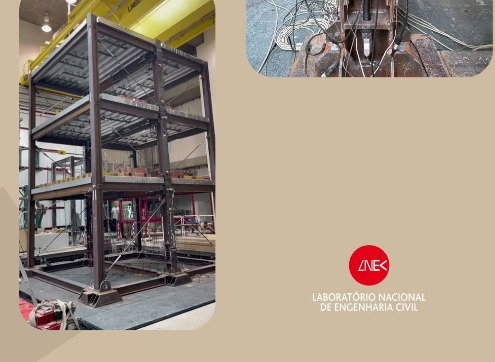
An international consortium led by University College London (UCL) is conducting large-scale experimental tests to evaluate an innovative self-centring technology for steel structures under seismic loading. The project is supported by ERIES (Engineering Research Infrastructures for European Synergies) funded by the European Union’s Horizon program, and brings together world-class universities such as UCL, Salerno, Stanford, Oregon State, Auckland University of Technology, as well as ARUP and LNEC.
According to Fabio Freddi, Associate Professor at UCL, the goal is to ensure that structures remain operational after major earthquakes. "The investigated self-centering technology allows structures not only to save lives but also to minimise downtime and continue operating after a severe seismic event", he explained.
The structure uses a combination of friction devices and post-tensioned bars to ensure a damage-free and self-centering response under extreme scenarios, including earthquakes with return periods beyond 2,500 years. The consortium also aims to validate how easily these structures can be repaired after testing, ensuring more sustainable and cost-effective solutions compared to conventional construction.
The team is now working on integrating and promoting the use of such technology into European seismic design standards. "We are already working on the definition of design guidelines and standards and are collaborating with industry partners such as ArcelorMittal to develop solutions that can be applied in real buildings".